New to Parmigiani Fleurier’s catalogue this year is the revival of the Toric collection, consisting of two time-only models and a chronograph rattrapante. The Toric is arguably the brand’s most iconic model as it was one of the initial collections when at their launch in 1996, and the early models now have never been more coveted among collectors who are gravitating towards this neoclassical design of the era. The Toric design has evolved through time and had been on a four-year hiatus since the previous one in 2020, which celebrated the 70th birthday of the founder and master watchmaker, Michel Parmigiani. With the new iteration of the familiar Toric, the design has evolved once again in a graciously modernised, simplistic manner, whilst subtly decorated.

Under the direction of CEO Guido Terreni, the bar is certainly set high to reflect the horological value and a highbrow proposition in the world of high-end watchmaking. There are several novel guidelines to keep the watches in line with the approach, which includes using only manual-wound movements, plates and bridges in gold, as well as dials, hour markers, hours and minute hands; cases are also made in rose gold or platinum.


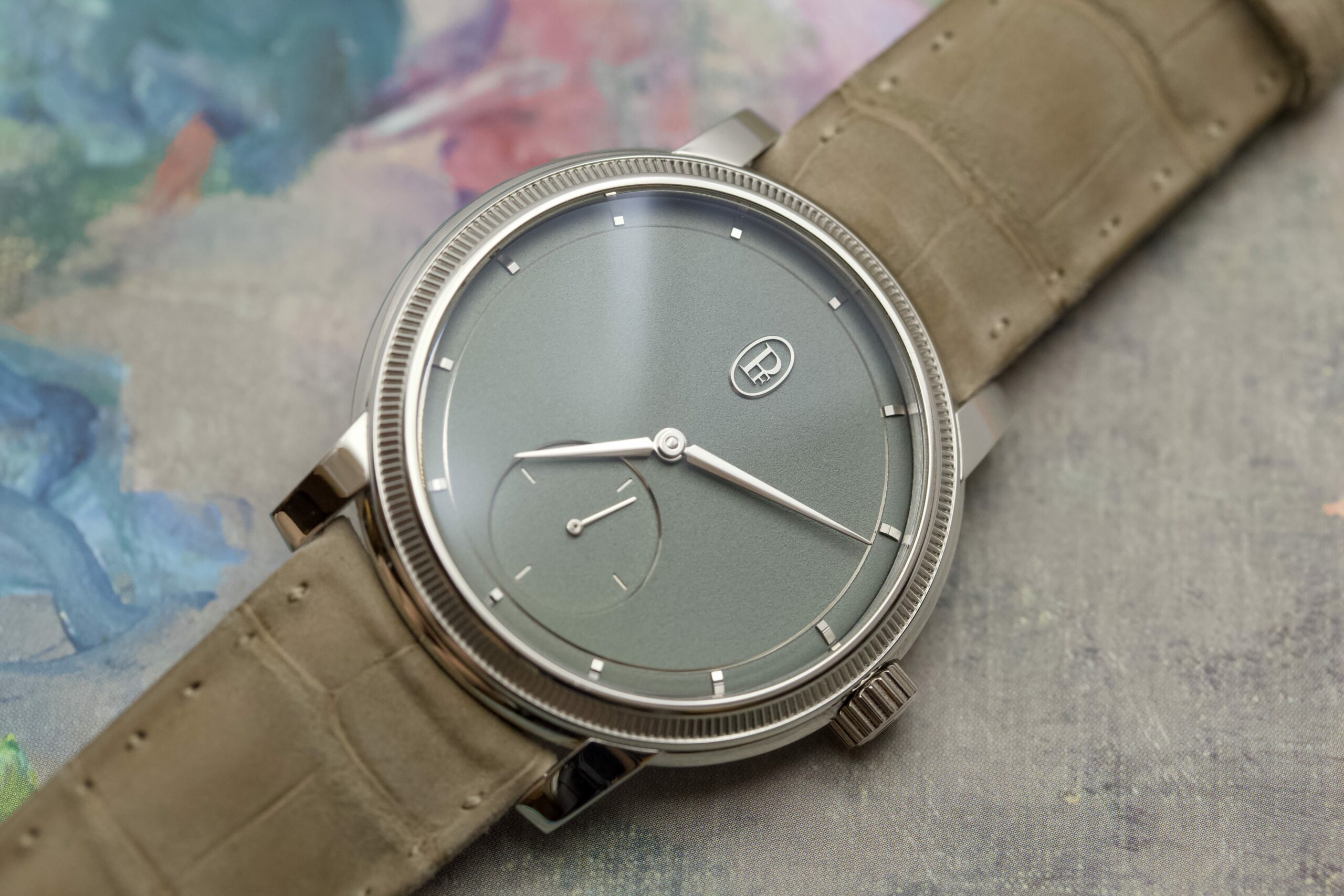
Whilst the recipe might sound unassuming and perhaps conventional, the design is quite the opposite of that and very much different from the familiar Toric collectors know from before, which depicted more of a classical, complication-focused aesthetic. Seen here is the Toric Petite Seconde in platinum. Rather than the usual colour of black, blue, and silver that is most considered safe to go with their suit, Parmigiani opted for this pale, gentle grey celadon that reminds one of the colour of a ‘60s Mercedes. And it has this soft, grainy texture, not to be mistaken with a sandblasted finish, achieved by polishing by hand with a special mixture of paste made of cream of tartar, crushed sea salt, silver, and demineralised water. The dial also drops slightly at the periphery as a thoughtful detail to play with shades and colour, and that goes quite well with the knurled bezel, a signature touch now on most Parmigiani watches, to create contrast and depth.


On the back of the watch, the layout of the calibre PF780 is tidy and pleasant, and the finishing is honest and perceivable. The surface of the rose gold bridges are ornate with the Côtes de Fleurier pattern, while the bridges of the double barrels and balance receive a mirror finish, and a good amount of hand bevelled anglage can be found throughout the edge of the components. A small portion of the base plate, with a contrasting sandblasted finish, is also visible underneath the escapement. Other notable details such as how the curvature of the plate matches the arc of the balance, the Parmigiani emblem, and beside the barrel bearing the signature of Michel Parmigiani surely help with the composition and add to the luxurious feel of the watch.

A design sketch depicting the Rose Gold variant, while also showcasing the lug profile inspired by the golden ratio.
There are two versions of the Toric Petite Seconde, one that is photographed here, and another one in a rose gold case with a sand gold colour dial. There is also a chronograph rattrapante in rose gold, limited to just 30 pieces, to demonstrate the commitment of the Toric collection as well as the capabilities of the independent manufacturer.