The history of luminescence in watchmaking is a journey of discovery and technological advancement. At the forefront of this evolution stands Panerai, from its early days as a supplier to the Italian Royal Navy to its modern innovations.

Modern: Truly Illuminating Panerai Submersible Elux Lab-ID
Text Cherie Wong
Photos Francis Cheung

In the early 20th century, Panerai was the precision instrument supplier for the Italian Royal Navy. With increasing demands on technical specifications, Panerai worked with Lieutenant Commander Carlo Ronconi for years to develop a radium-based powder. This was applied to the dial of the early “Radiomir”, the first of many patented models, allowing the dial to glow with self-generated light energy from the radioactive compound; it became one of the earliest luminous materials applied to watches. Due to the inherent health risks to workshop workers in close contact with radium (and to a lesser extent, the wearers), Panerai sought alternative approaches for a different collection, “Luminor”. In the 1960s, a new and somewhat safer material, tritium, was introduced. Although this material is also radioactive, it is less potent than radium, but it also has a relatively short half-life and would lose its luminescence after a few years. Today, tritium is no longer used given its radioactive nature, but it is still sought after by vintage watch enthusiasts.. Less harmful materials were developed in the early 1990’s, such as LumiNova, and later SuperLumiNova, which are widely used by different watch brands today. However, these are not inherently luminescent, and require exposure to a light source to be activated, and they generally glow for a few hours only.

Going back to 1966, Panerai filed another new patent for Elux, an abbreviation of “electroluminescence” (meaning electroluminescence). This technology maintained constant luminescence via an electric field through electroluminescent panels, powered by portable batteries and a fixed AC supply. It became a sustainable source for the Italian Navy to maintain constant, durable, and shock and vibration-resistant support for crucial devices and luminous signage for helicopter landings on ships. With the support of quartz movements in the 1980s, electroluminescence became popular among digital watches, powered by button batteries.

This year, drawing from the historic Elux concept, Panerai has launched the new Submersible ELux LAB-ID (reference PAM1800), using a newly developed patent that allows mechanically charging lighting pots (literally plant with LEDs) on demand, for up to 30 minutes. The Panerai Laboratorio di Idee department spent eight years on research and development for this new initiative to transform kinetic energy into light.
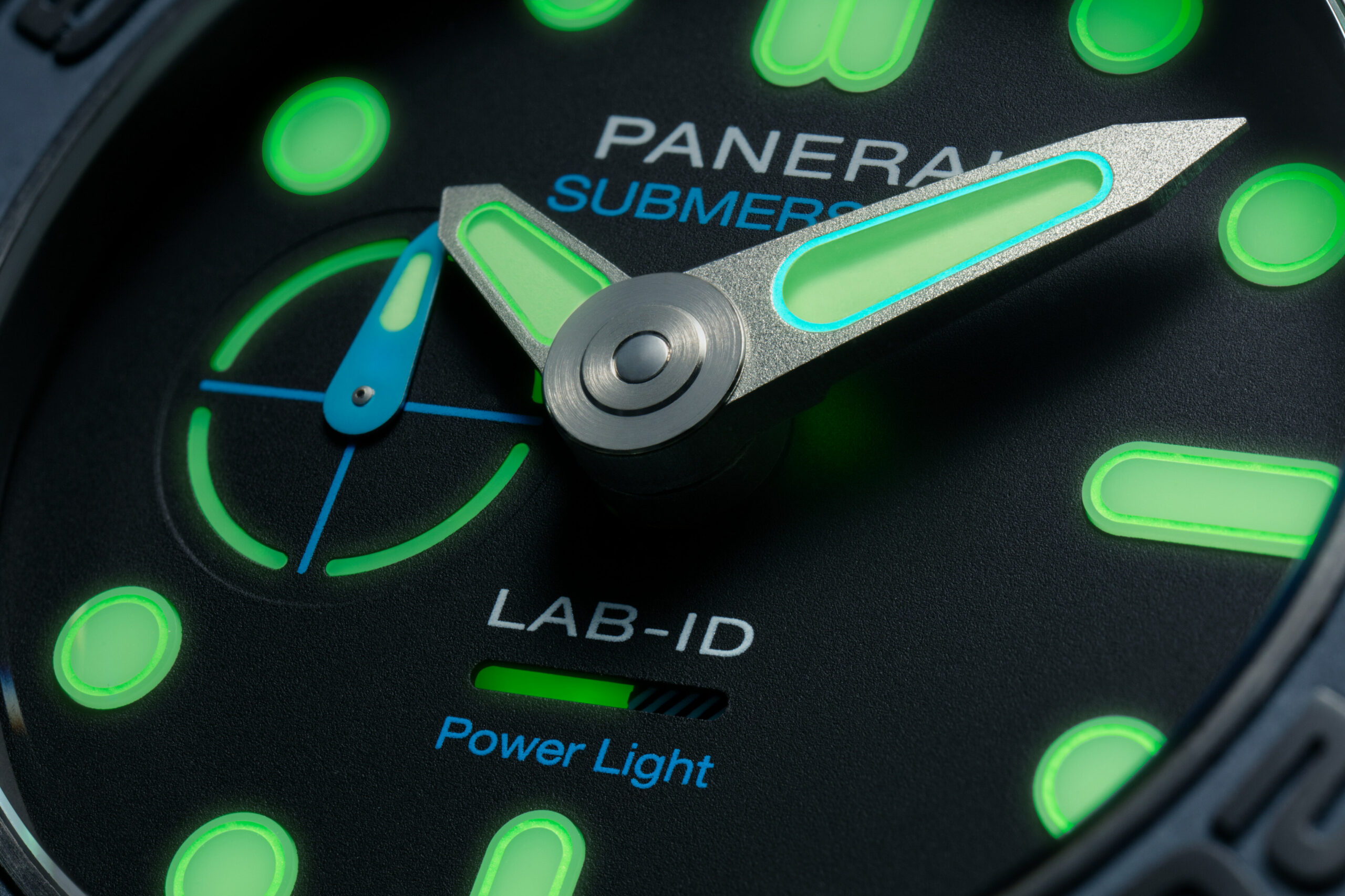
To provide sufficient energy, the movement, caliber P.9010/EL, bears six barrels with a three-day power reserve. The extra four barrels added to the original movement are made to power the mechanical microgenerator-powered LEDs lights for up to 30 minutes. By pressing the on-demand pusher (protected by a patented protector) at eight o’clock, the microgenerator converts mechanical energy into electricity using a high-speed rotor operating at 80 revolutions per second and generating a high-frequency electrical signal of 240 Hz.

The LEDs are implanted in various parts of the dial, including the bezel marker, power reserve, and small seconds sub-dial. It is especially challenging for the parts that require synchronicity with the movement; a noteworthy example is the “lume” marker on the bezel. Instead of powering all 60 LEDs on the bezel from the microgenerator, the electricity is directed to 15 dedicated LEDs below the positioned marker. After the LEDs turn off in 30 minutes, the green SuperLumiNova X2 on hour markers and hour hands, and blue SuperLumiNova X1 on the minute hand and bezel dot, continue to allow time reading in the dark.

The movement is encased in a blue Ti-Ceramitech 49mm case, crafted from ceramised titanium through a process called plasma electrolytic oxidation, offering a special blue color that resonates with the shades of the open seas. The lightness of the chosen material counters the boldness of the size.


The reference PAM1800 represents a groundbreaking culmination of over a century of luminous innovation. The use of kinetic energy to power on-demand LEDs lighting provides a durable, reliable, and consistent light source that pays homage to the brand’s naval roots, and is an intriguing merging of traditional watchmaking with electromechanical components.