We recently had the occasion to talk with two of the key members from Laurent Ferrier during their visit to Hong Kong, Christian Ferrier, son of the founder and Head of Brand Patrimony, and Robert Bailey, Head of Sales, about the brand’s latest creation, the Classic Moon. They also shared their insights about the watch market in general and the brand’s future direction.

Intelligence: In conversation with Christian Ferrier and Robert Bailey
TEXT and PHOTOS Francis Cheung

Christian Ferrier (left), Head of Brand Patrimony; Robert Bailey (right), Head of Sales
What is the biggest concern or challenge in developing the Classic Moon?
C : To have a collection, a new collection, it’s more difficult because there are a lot of ideas. It is important to make sense to the collectors, especially when my father is so creative. A good example is the special piece, the Only Watch collaboration with Urwerk; it was fantastic for my father to work on these kinds of pieces because it was impossible to do it in our collection. These design timepieces have a style collectors will appreciate.
This is a good exercise because a lot of people are waiting for the result of this kind of timepiece, because we need to go a bit far from the very classic watches like this one, we really are aiming for a watch that still have the DNA of the brand in the other model, because everything changes, the case is of course the most difficult part, so are the dial and the indexes, but we can see a lot of Laurent Ferrier in this watch, I think, and a lot of people agree.
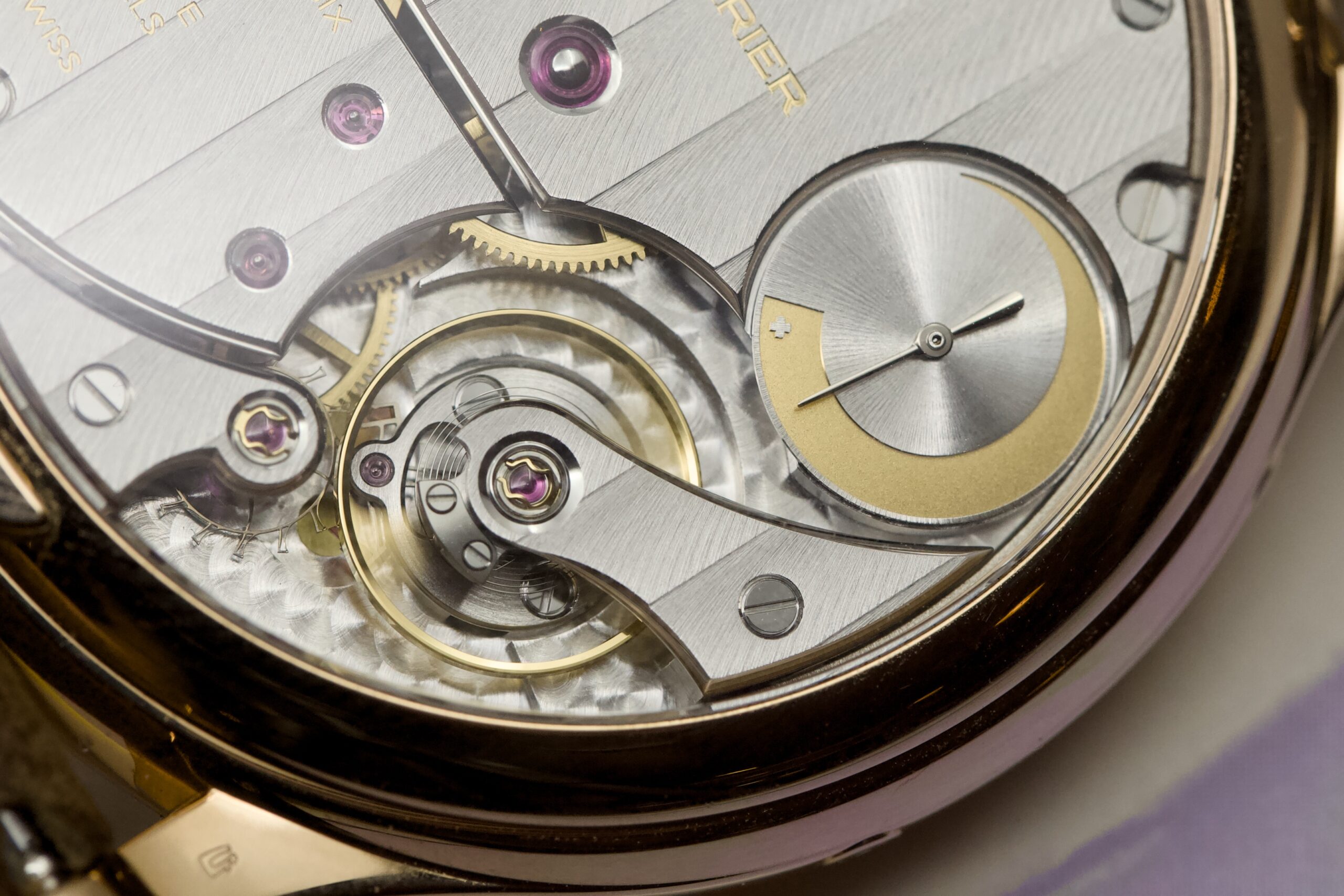
It is also the small things, especially in all the details because in Laurent Ferrier we always pay attention to the details, it’s the main thing for the brand’s philosophy.
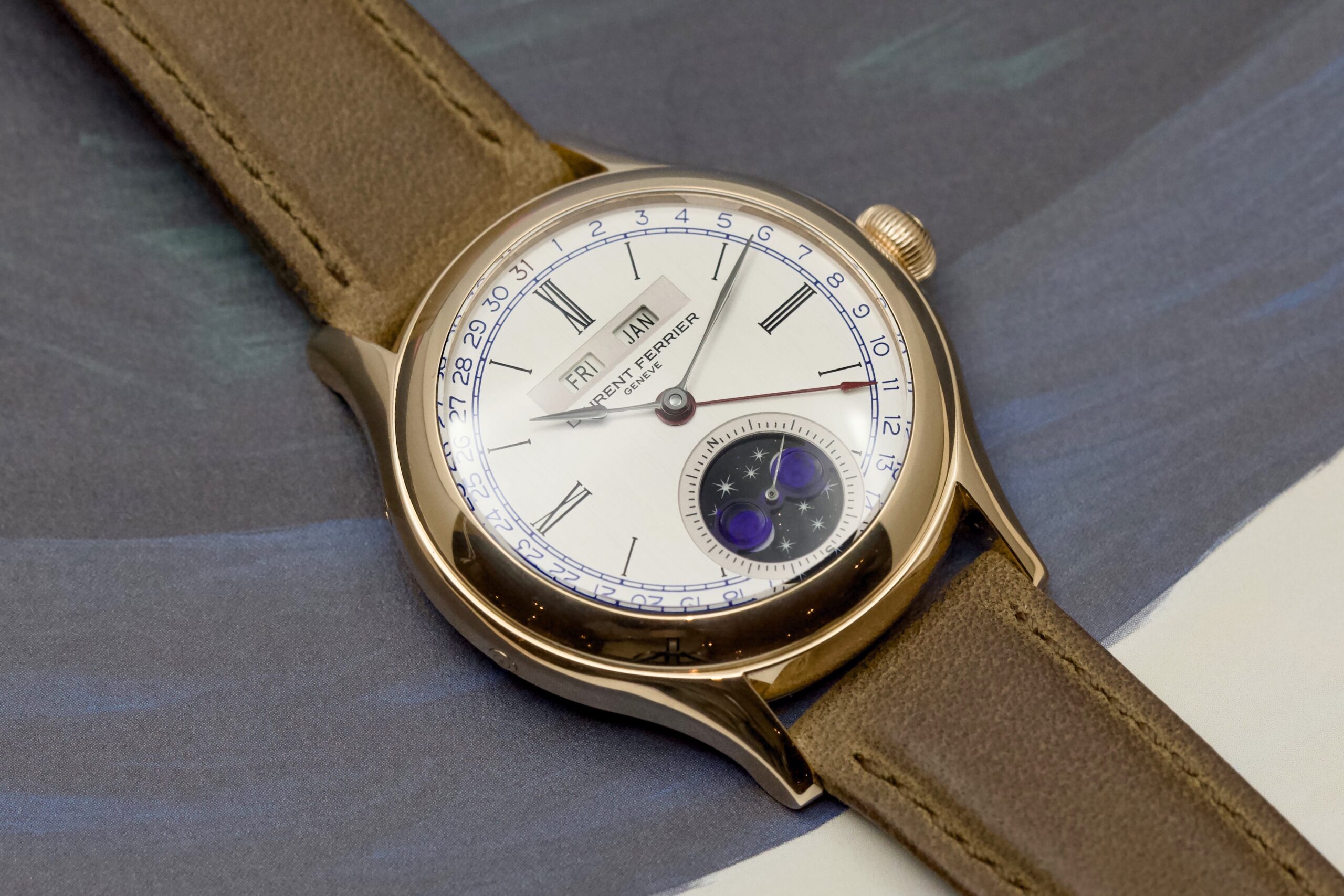
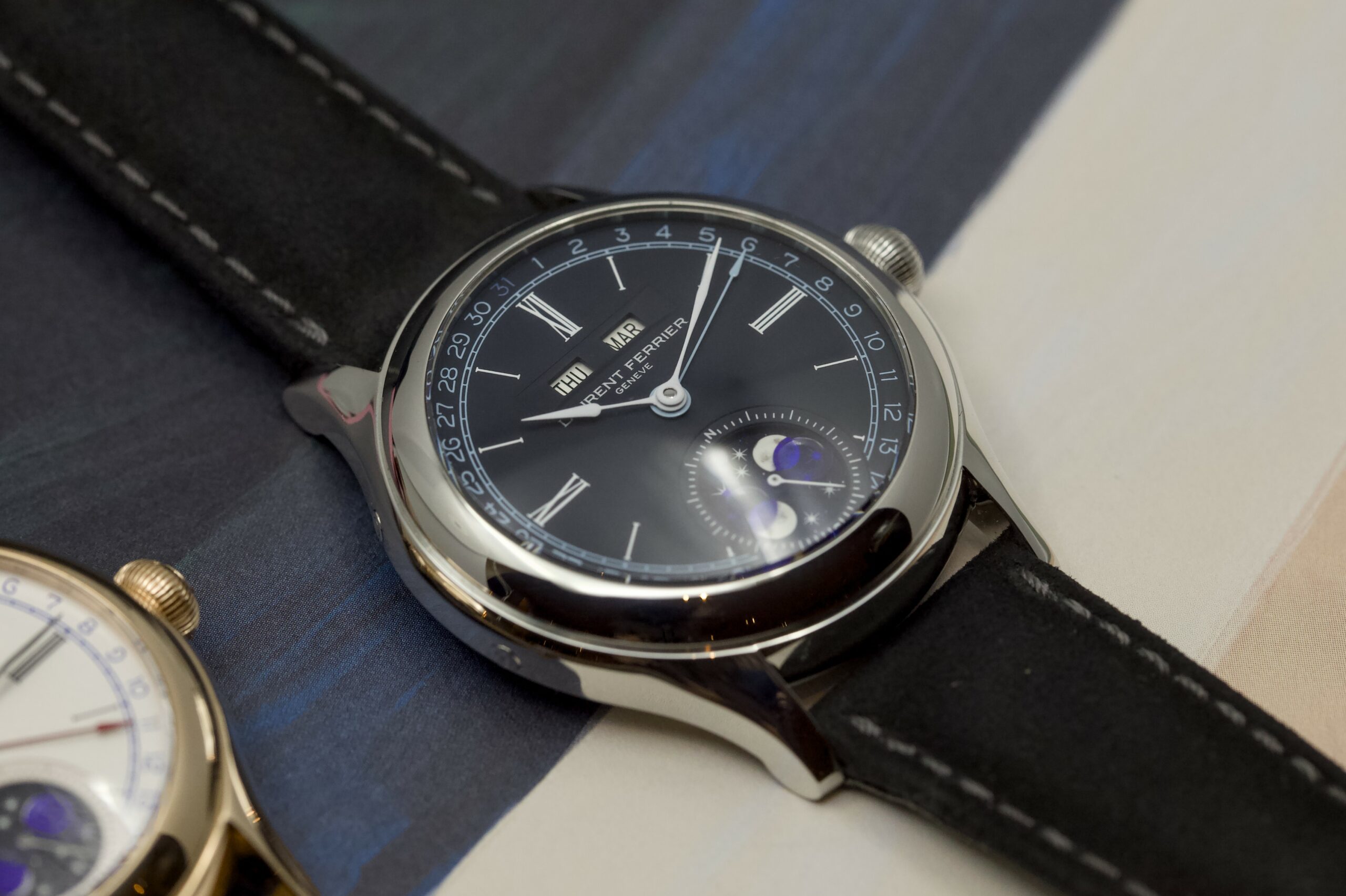
It’s not exactly a complete novelty, but an evolution of our annual calendar. Inside, you can see the difference but it is simply better. And of course we developed all the components including making the moon, it is a lot of work. Now the moon is full of these small things in a small second, and all the details are concentrated in the space, and about the moon it’s what we called métiers d’art in French, we can find enamel, the stone aventurine, and glass from Murano.
R : It’s aventurine glass, so basically this isn’t aventurine stone, it looks similar. But it’s a Murano glass, it’s fused with copper, and gives it that night sky kind of look to it.
C : The bridge is grand feu enamel, translucent, still thin so it’s not easy to do and we concentrate all the métiers d’art in this small space and the small second. We always explain that in the collection, we can do this because of the quantity, with a low quantity like that we can go a bit far on the details, it is why it is interesting, we have changed to work like that with this small quantity collection. It is not a problem to choose design, because first thing design is pleasure for your eye, and sometimes you have to make compromises and the quantity is the main compromise in this case. And it takes time, the moon and the bridge. It takes three weeks.


What was the inspiration of the Classic Moon?
C : The moon is a very special thing, because my father who has explained and I completely agree, is that the moon phase is always wrong, people always wanted to have the moon phase but it doesn’t really matter if it is exactly correct, but this is a bit poetic you know? But of course it’s technical to have a perfect moon, but as my father always explained, we don’t really need it, it’s just for the pleasure for the eye and this is why we choose two moons, to have a good balance on your eyes, which a lot of people really appreciate. The big moon is really famous in the watch industry, but for a small moon like this it is very classic and very elegant on the dial, so this is why we go to this way for the evolution of the watch. I am not sure about Hong Kong, but in Europe the moon is traditionally related to certain events, for example getting a haircut.
How did you come about with the colour combinations?
C : From the beginning me and my father, we have a designer at work responsible for generating beautiful pictures and 3D graphics. So at the beginning the most important thing to do is prototype. Because it’s always better to see the colour and design in reality. We have a very close relationship with our supplier so we can always try until we are satisfied and be like “ah, it’s this one”. It’s interesting, my father’s choice was for this one, the opaline, without gradient. And through experiment and prototyping we can then choose the one with a better visual balance. The grey one is easy to wear on most occasions, while the gold one is relatively more formal. It respects the code of complication with its case and the satin finish plate that shows differently under light.
We have seen in recent years the rise of recognition towards independent watchmaking. What do you think are the elements and values that collectors most appreciate?
R: I think it’s the contact with the brands, to meet with the creator and to speak with them. The big groups do this to some extent but it’s harder to reach their people. And I also think it’s the freedom of creativity, small independent brands, the person running the brand is often the head of the company, they can do whatever they like basically. Unlike more established brands they might have these creative counsels to validate new designs to keep things in a consistent manner.
We have the ability to jump out of the trend and come up with something very interesting.


From your perspective, where do you see, from regions around the world, the strongest interest in independent watchmaking, or perhaps the most potential?
R: I think it’s pretty worldwide, the interest. In the beginning I think it was definitely Asia that led the way, the early adoption happened in Asia but I think now the rest of the world has caught up. But especially for markets like Hong Kong, Singapore, and Japan, they are very mature. And I think Covid helped us quite a lot, basically people stuck at home, they have much more free time to investigate new watches, i think that’s really when people began to notice the independents.
Also another thing is our clients are very mobile, so we don’t really know if a client buying in Japan is Japanese, but for us we have seen Japan is a much more classic market than say Singapore, our classic collection performs better in Japan than in Singapore. Conversely the sports collection works better for Singapore than it would in Japan. The percentages vary a little bit between different markets, like colour is sometimes culturally specific and places like the Middle East, the greens and the salmon are really appreciated, they have religious significance for them. And for the other countries, say the Northern Europeans, it’s usually the greys, whites and blacks.
C : And the preference of the new generation is different, and it’s very important for the future of course and its very interesting from the beginning of the brand, I was shocked by the interest from the new generation for the classic watches,
R : We have seen some new generations gravitating towards the classical watches more nowadays, while we might have thought they would be interested in some more contemporary designs in our collection.


We have seen some successful collaboration in the past with Urwerk and Phillips. How did that come about?
C : For Urwerk, it was just one day my father had the occasion to meet Felix [Baumgartner], and had the idea of a collaboration for a new watch, and he proposed to just give a calibre of Urwerk, for my father it’s easy to machines this kind of things, he is so creative. For Urwerk, it was just so much, he came to me with the computer and the software and explained to me what he thinks about this case and I started to draw. After that he changed the lines to find a good shape. It was a pleasure to create like that.
And for Phillips, we have a very good relationship with Aurel Bacs, it was fantastic. He just said, “Can we do not only a watch but a classic case?”, and we went to Phillips and saw several watches; of course we know this kind of case from the past, it was a standard case for the watchmaker who just needed a case to work on the calibre, but that’s why we found a lot of these kinds of cases with different details. And Aurel, he really wanted to have this kind of case, very classic, and just change small things. My father would then say “Maybe this is not a good idea, see if we change the size of the lugs, if we go too far it would be less comfortable”, and he learnt a lot because he came to our place to see. We did the limited series for Phillips and it was very interesting. If we agree with this kind of thing, it is a pleasure to do that, but it would be a bad idea to do that every year, a new case for everybody, because it is important to focus on the Laurent Ferrier DNA, to focus on our own creation. But sometimes it’s a pleasure to be creative.


Will there be any more collaborations in the future?
C : We have a focus on the production and the quality first, we really don’t want frustration from the collectors. As you said before in the beginning, when we launched this one, there was a two year waiting list and it’s a bit too much. Neither the new or the old generation of collectors are very patient. Now we are really focused on the current collection, and this is why we don’t really work on limited series. We appreciate that for the creative part, but we really need the attention on our collection.

What would be the future direction or focus of the watches you create, could it be developing more calibres for higher complications, explorations on design, or achieving an even higher level of finishing?
R : All of the above. Basically, in vague terms, we have a new watch that we will launch next year. It is an existing movement but we put it into a different kind of case shape, that’s coming next year. Then in 2026, we will have another variant of our sports watch, so basically a kind of complication in a sports case. And in 2027 we will have a big new launch of a brand new complication. I can’t tell you exactly what it is but I think if you look at the collection you can probably guess what is missing.
C : Now we want to have a good collection that makes sense. If you look a bit in the past, you see we don’t have all the new watches we do in Laurent Ferrier, and we really want to clean the collection. This is why in the future you will see not a complete new watch but an evolution, the same as the classic moon. And of course the complication, we have a very nice collection with specific micro rotor, natural escapement, very technical, very smooth, elegant and pure horology, hand winding. Of course, complications take time, and we have time.